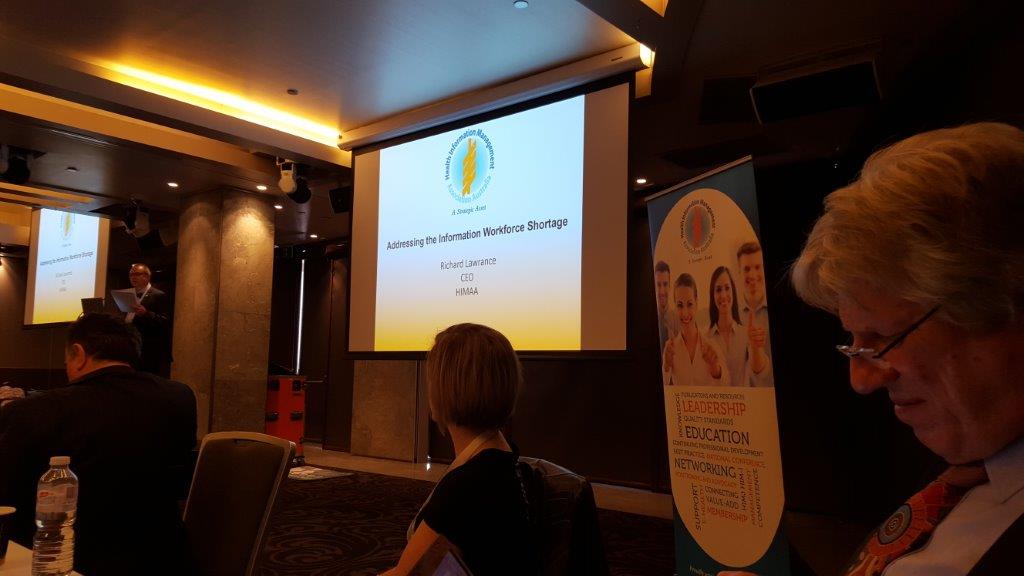
 This time last week I attended the HIMAA Workforce Summit in Sydney, Australia, as an ACHI Fellow representing the New Zealand health informatics workforce. It was great to see many New Zealanders in the 100 strong group of people there, who share my concern that we need to urgently and comprehensively develop health informatics and health information management capability and capacity for both our countries.
I presented the recent update to the NZ Health Strategy (of 2000). Health informatics initiatives such as telehealth and patient portals are in the heart of this update. Parallel to this update, the NZ National Health IT Board released a report last month at the HiNZ conference in Christchurch, by Deloitte exploring the value of a national EHR for NZ, and its implications on the National Health IT Plan, which is also being updated. These updates imply, but don’t specify, the need to rapidly develop digital capacity and capability in NZ to be able to pull off the substantial contribution that is expected of health inforamticians and health information managers.
There were some interesting (and at times depressing) reports about the persistently low enrolments in postgraduate and undergraduate programmes available in Australia, mirroring the New Zealand situation (although it appears that NZ has more tertiary programmes than Australia). The Summit is reported in today’s PulseIT newsletter.
The day concluded with report-backs from break out groups that examined aspects of the workforce issues identified in the Australian Institute of Health and Welfare’s research report of 2009. I was scribe and rapporteur (I learnt a new word) for the group on health informatics, chaired by ACHI President, Klaus Veil. Our group discussed issues such as
- the many languages health informaticians use (medical terminology, suite (manager) speak, geek (computer science) speak, health informatics lingo, and English as an additional language for many),
- the need for a strong identity and presence of health informaticians in interprofessional healthcare teams,
- identify role models,
- a clear health informatics voice, and
- a strong call for active and committed collaboration.
The call to action from the group was to ‘get out of our comfort zones’ and never forget that what we do is ‘all about the people we serve, patient outcomes and great health care for all’.
We have a lot of work to do to achieve this dream! What will your contribution be?
 Day by Day
Leave a comment