On Tuesday, 13 Oct, I hosted a showcase seminar of the six shortlisted students for the Sysmex Prize. This annual prize applies to the students of my undergraduate health informatics course from the Bachelor of Health Sciences.
How can health informatics innovations improve quality of care?
Abstract This showcase of student work from the Health Informatics course in the Bachelor of Health Science demonstrates the talent our students have for solving healthcare quality issues. The whole class of 58 students was asked to write a business case proposing a health informatics solution to a healthcare quality problem that they identify, and submit it for consideration for the Sysmex Prize for Health Informatics. The prize consists of $1,000 plus free registration to attend the annual HiNZ conference. Once the business cases were graded for academic purposes, the 20 students who marked their business case for consideration for the Sysmex prize were considered by me and a representative from Sysmex to identify a shortlist and then a winner.
This year we showcased the ideas of six students who formed the shortlist. We invited people to come and hear about their ideas before the winner is announced on 20th October at the HiNZ conference Gala Dinner in Christchurch. The showcase was hosted by me, Dr Karen Day, Champion of the Health Information and Analytics Pathway for Bachelor of Health Sciences, and Director of the Postgraduate Programme in Health Informatics.
The presentations Each student had five minutes to tell us what problem they explored and describe the innovation they created as a solution to that problem.
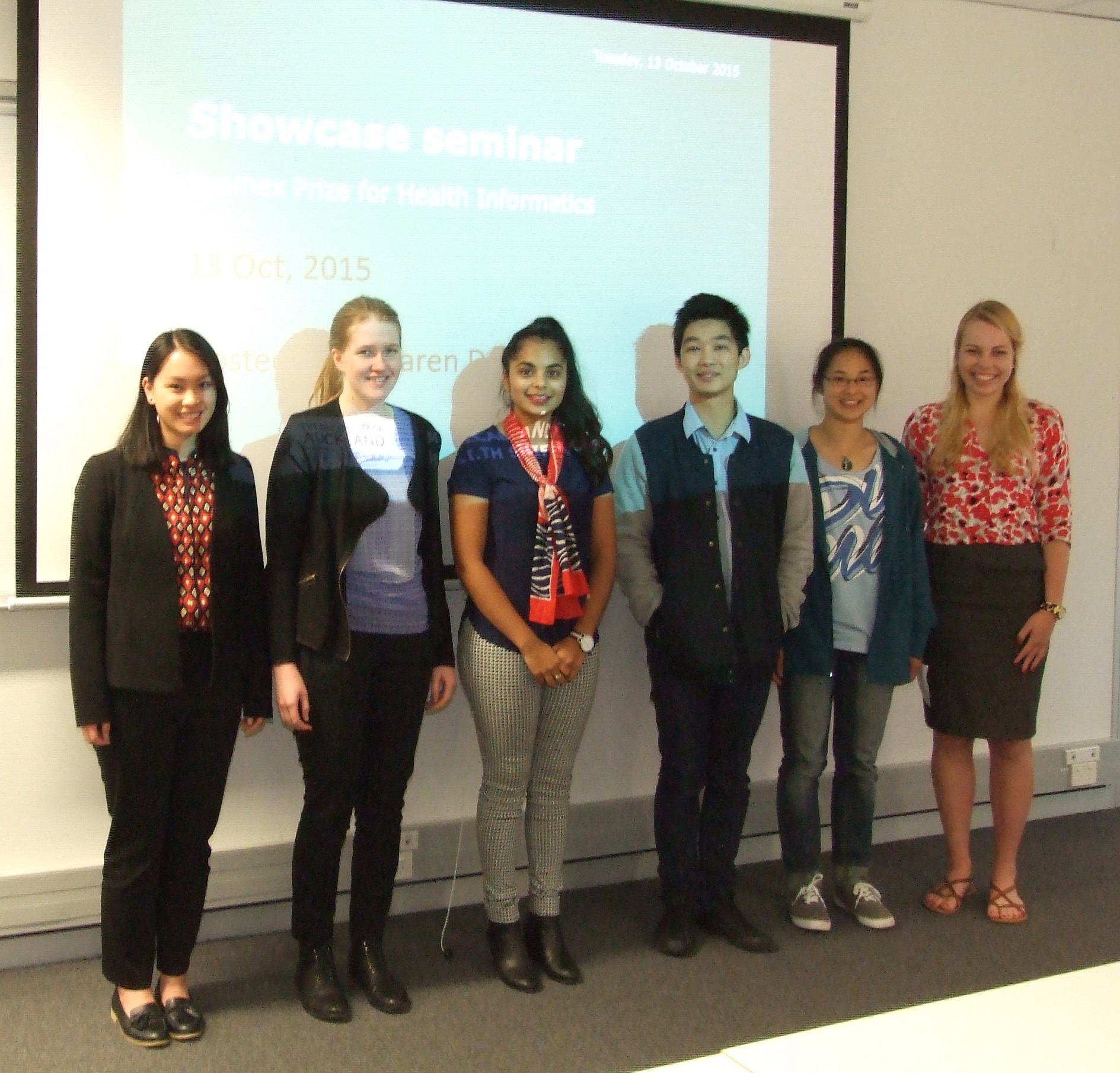
May Lin, Jesse, Sharndre, Michael, Namali and Augusta.
| Sharndre Kushor | Improving Quality of Care through Telemedicine- GPnearMe
Problem: Primary care services could be more accessible and efficient for people who find it hard to attend in person. Solution: Videoconference services on mobile phone, with the patient’s GP, booked online and followed up online. |
| Augusta Connor | Summoning mHealth to Combat Asthma among Maori Children in a Primary Care Setting
Problem: Parents of Maori children with asthma have difficulties getting their children to take medication, and how healthcare interactions occur in a consultation can be culturally distancing. Solution: Development of a personalised mhealth programme that encourages personal, social and culturally comfortable interaction between Maori parents, their children who have asthma and their clinicians, and support effective use of asthma medications. |
| May Lin Tye | LOOP: An innovation to facilitate test result follow-ups in primary care
Problem: Laboratory results return to primary care services and are followed up according to manual processes that are tailored to each GP’s preferences. If lab results are normal, then ‘no news is good news’ applies and patients are not notified. Some lab results are missed, some follow up is lost. Solution: Two-fold solution. 1. Case list management automated in the GP practice management software. 2. Once GP signs off lab result, patient receives automated phone message to indicate if result is normal and no action required, or if appointment is required to discuss and action the result. |
| Michael Young | MediTracker – “Right dose, right time”
Problem: It’s hard to take medicines as prescribed and people lose track and sometimes lose their medicine containers. Solution: Medication management software to track taking meds. Plus accelerometer on bottle cap that counts and tracks when bottle opens and meds are taken. Plus Bluetooth facility to find lost bottles using mobile phone. Plus gamification with rewards when meds are taken as prescribed. |
| Namali Xian | Reach More, Be More (RMBM)
Problem: Older people want to keep on living at home as long as possible. Clinicians, volunteers and support services want to help keep older people at home. Solution: A social media-like diary management system that allocates tasks to providers (volunteers, clinicians and service providers), gives older people ability to rate those who help, offers emergency call service if in danger/need immediate help, supports communication between users and providers, facilitates older people’s requests for assistance. Uses mobile technology. |
| Jessie Gates | MediMate: An mHealth Innovation for Palliative Care Patients
Problem: People in palliative care have complex needs that change often. Meds change, are difficult to track, review, and revise. Solution: An electronic medication tracker that holds all a person’s meds, tracks current meds, is update-able, allows for notes about effects and side effects of medications, is viewable and useful for prescribers, patients, support people, palliative workers, and others who contribute to palliative care regardless of setting. |
 Day by Day
Leave a comment